World News

Random Post

Showing posts with label Tradition. Show all posts

Monday, May 26, 2014

About Chittorgarh Fort in India

Chittorgarh, also called Chittaur, from the 7th century to the 16th, was the capital of Mewar under the Rajputs. Chittorgarh is the epitome of Rajput pride, romance and spirit. Chittorgarh Fort is a massive and majestic fort situated on a hilltop near Chittorgarh town in Rajasthan state in India One thing the Indian State of Rajasthan certainly has are some really magnificent old forts to look around and Chittorgarh Fort is certainly worth visiting. Chittaur evokes memories of great heroism and sacrifice by Rajput men and women in the intermittent battles that they had to fight against invaders from Northwest or Delhi. Chittaur witnessed both the ravages of war and the triumphs of the spirit. Allaudin Khilji who coveted Queen Padmini of Chittaur, invaded the city in 1303 A.D. Queen Padmini and the women of the court sacrificed themselves in a pyre of fire rather than submit to anybody.

Tuesday, May 13, 2014

Cambodia Culture & Traditions

The culture of Cambodia has had a rich and varied history dating back many centuries, and has been heavily influenced byIndia & China . Throughout Cambodia's long history, a major source of inspiration was from religion. Throughout nearly two millennium, Cambodians developed a unique Khmer belief from the syncreticism of indigenous animistic beliefs and the Indian religions of Buddhism and Hinduism. Indian culture and civilization, including its language and arts reached mainland Southeast Asia around the 1st century A.D. It is generally believed that seafaring merchants brought Indian customs and culture to ports along the Gulf of Thailand and the Pacific while trading with China. The first state to benefit from this was Funan.

Tuesday, May 6, 2014

Petra was the impressive capital of the Nabataean kingdom .

Deep within the deserts of Jordan lies the ancient city of Petra. Through a narrow gorge it emerges into view, revealing awe-inspiring monuments cut into the surrounding cliffs. What is this astonishing city? Who built it, and why?

Two thousand years ago, Petra stood at a crossroads of the ancient near east .Camel caravans passed through, loaded with spices, textiles and incense from distant regions--and through such commerce, the city flourished. Its people, the Nabataeans, harnessed precious water, enabling the population to soar to perhaps 20,000.
The Nabataeans also erected monumental tombs, memorializing their kings and leaders. But over time political control changed, and so did trade routes. Eventually the city fell silent, forgotten by the outside world.

Saturday, May 3, 2014

The San people known as Bushmen

The 'Bushmen' are the oldest inhabitants of southern Africa, where they are commonly known as Bushmen, San, Khwe or as the Basarwa. They have been resident in and around the Kalahari Desert for at least 20,000 years. Which spans areas of South Africa, Botswana, Namibia and Angola. The terms San, Khwe, Bushmen, and Basarwa have all been used to refer to hunter-gatherer peoples of southern Africa. They speak a variety of languages, all of which incorporate 'click' sounds represented in writing by symbols such as! or /. Genetic evidence suggests they are one of the oldest, if not the oldest, peoples in the world
They were hunter-gatherers, hunting with bows and arrows, trapping small animals and eating edible roots and berries. They lived in rock shelters, in the open or in crude shelters of twigs and grass or animal skins. They made no pottery, rather using ostrich eggshells or animal parts for storing and holding liquids.

Thursday, January 30, 2014

Pygmies of Africa


Short people known as pygmies are scattered across equatorial Africa, where they speak various languages, inhabit different types of forests, and hunt and gather food in diverse ways. Despite their cultural variety, a new study shows that the pygmies of Western Central Africa descended from an ancestral population that survived intact until 2800 years ago when farmers invaded the pygmies' territory and split them apart. Many anthropologists define pygmy as a member of any group where adult men are on average less than 150 cm (4 feet 11 inches) tall.
The ‘Pygmy’ peoples of central Africa are traditionally hunter-gatherers living in the rainforests throughout central Africa.

Wednesday, January 22, 2014

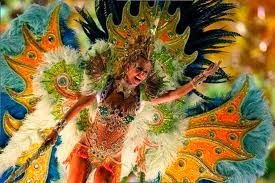
Samba dance of Brazil.


Samba is  one of the most popular dance. Samba is a lively, rhythmical dance of Brazilian origin in 2/4 time danced under the Samba music. The dance simply follows the beat of the music and can go from average pace to very fast. Men dance with the whole foot on the ground while women, often wearing heels, dance just on the balls of the foot. Professionals may change the steps slightly, taking 4 steps per measure instead of 3, and often add various arm movements depending on the mood of the music.Samba has a very specific rhythm, highlighted to its best by characteristic Brazilian musical instruments. Now it moderately popular ballroom dance, limited pretty much to experienced ballroom dancers because of its speed. More than 20 different types of samba in BrazIl.